Camera knowledge base
Understand the specs before you buy
No simplistic camera rankings. We explain specifications and use cases first, then help you narrow the field.
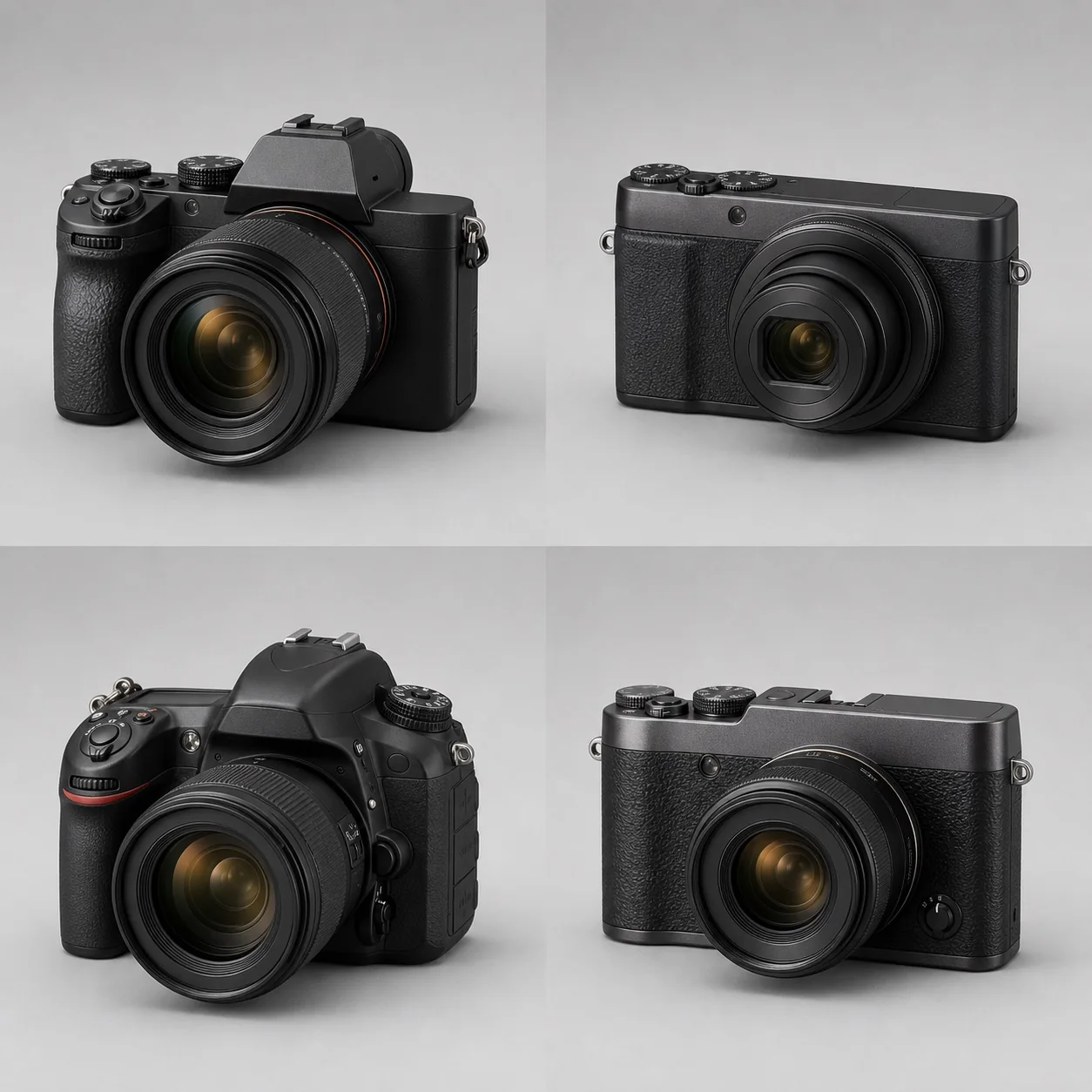
Articles, tools, and methods
Mirrorless vs. DSLR Cameras: What's the Difference, and Which Should You Buy?
The main difference between mirrorless and DSLR cameras is the presence of a mirror and optical viewfinder—not inherent image quality. Compare lens ecosystems, autofocus, video, battery life, size, service, and used-market prices before buying.
Read guide →Mechanical vs. Electronic Shutter: Which Should You Use?
Mechanical shutters control exposure with curtains, while electronic shutters use the sensor. Electronic shutters are silent and support faster bursts, but may be limited by rolling shutter, flicker, bit depth, and flash synchronization.
Read guide →What is the difference between RAW, JPEG, and HEIF—and which should you save?
RAW files preserve data closer to the sensor and leave more room for adjustment; JPEG files are compatible and processed; HEIF can offer greater efficiency or bit depth, but compatibility is usually weaker.
Read guide →What is the difference between in-body and lens stabilization? Can they work together?
In-body stabilization moves the sensor, while lens stabilization moves an optical group; whether they can work together depends on the camera, lens, and firmware. Advertised stops cannot be added directly, and neither system can freeze subject motion.
Read guide →Can You Use Full-Frame Lenses on APS-C Cameras? What About the Reverse?
Whether a full-frame lens works on an APS-C camera depends first on the mount; when compatible, it usually does. An APS-C lens on a full-frame body may cause vignetting or trigger crop mode, reducing output resolution.
Read guide →Can Lenses from Different Brands and Mounts Be Used Interchangeably?
Whether a camera lens can be used interchangeably depends first on the mount, not the brand name; cross-mount use usually requires an adapter and may affect autofocus, stabilization, correction, and firmware compatibility.
Read guide →How to Choose Between Prime and Zoom Lenses
The better choice between a prime and a zoom lens depends on your subjects, what you are willing to carry, and how often you want to change lenses. A zoom covers multiple angles of view, while a prime makes it easier to get a wide aperture, compact size, or high image quality—but neither is always superior.
Read guide →How Should You Understand Equivalent Focal Length and Crop Factor?
How is equivalent focal length calculated? Multiply the lens's actual focal length by its crop factor relative to full frame; this compares angle of view only. This guide also explains equivalent aperture, total light, and common APS-C and M43 conversions.
Read guide →What Does Lens Focal Length Mean? What Different Millimeter Values Can Capture
Lens focal length is the distance from the principal plane to the image-side focal point when the lens is focused at infinity; together with sensor size, it determines angle of view. This guide explains wide-angle, standard, telephoto, and perspective.
Read guide →How Does Image Noise Occur? The Effects of High ISO, Long Exposures, and Underexposure
Camera noise comes from photon shot noise, read noise, and thermal noise. This guide distinguishes high ISO, long exposures, and lifting underexposed images, then gives practical shooting and post-processing noise-reduction strategies.
Read guide →What is dynamic range, and why can't highlights and shadows both be preserved?
Camera dynamic range is the brightness range in one exposure, from unsaturated highlights to usable shadow detail. Learn about RAW latitude, highlight recovery, shadow noise, HDR, and how to read test results.
Read guide →Do more megapixels always mean better image quality?
More megapixels can provide extra detail and cropping room, but image quality also depends on the lens, focus, camera shake, diffraction, processing, and output size. More pixels do not automatically mean better high-ISO performance, dynamic range, or color.
Read guide →What Controls Depth of Field? Blur the Background or Keep More in Focus
Depth of field depends on aperture, focal length, focus distance, and viewing conditions. Learn about format, portrait background blur, hyperfocal distance, diffraction, and focusing mistakes.
Read guide →Why are my photos blurry? Focus, camera shake, and subject motion
Diagnose blur by its shape: detail in front of or behind the subject suggests missed focus; matching trails across the frame suggest camera shake; blur only on moving parts suggests subject motion.
Read guide →Why does high ISO look noisier, and how should you set it?
Set ISO after choosing the aperture and shutter speed your subject needs. Learn how digital ISO, high-ISO noise, base and extended ISO, Auto ISO, and underexposure trade-offs work.
Read guide →How to choose a shutter speed for different subjects
Choose shutter speed by considering focal length, subject speed, stabilization, and your own steadiness. Use these starting ranges for portraits, pets, sports, birds, and long exposures.
Read guide →Why does a smaller F-number mean a wider aperture?
An F-number is the ratio of focal length to entrance-pupil diameter, so a smaller number usually means a wider opening. Learn about stops, depth of field, diffraction, and choosing an aperture.
Read guide →Aperture, shutter speed, and ISO: how the exposure triangle works
Learn how aperture, shutter speed, and ISO work together. Choose depth of field and motion first, then use ISO to reach the brightness you need.
Read guide →What should you look for in a camera? Start with five questions
Choose a camera by defining your use case, then checking the sensor, lens system, autofocus, video, handling, and total system budget.
Read guide →Full frame or APS-C: which should you choose?
Full frame or APS-C? Compare sensor area, low-light performance, resolution, body weight, and lens cost, with advice for different shooting styles.
Read guide →One camera, several market names
Match Canon, Panasonic, and other camera model aliases used across European, North American, Japanese, and other regional markets.
Read guide →How accurate are these numbers?
Learn how CameraLore calculates sensor diagonal, pixel pitch, pixel density, and crop factor.
Read guide →Camera sensor size comparison
Compare 1-inch, APS-C, full-frame, and medium-format sensors at true proportions.
Read guide →How pixel pitch and crop factor are calculated
See the formulas, assumptions, and error bounds behind our derived data.
Read guide →Why one camera can have several names
Understand model aliases used by Canon, Panasonic, and others across markets.
Read guide →Start with the sensor
Area affects light-gathering potential as well as the size of the body and lens system.
Then check derived metrics
Pixel pitch and density need the context of release date and sensor architecture.
Finally verify the model
Regional aliases differ, so confirm that names refer to the same camera before buying.